SaGE Workspace Review 2026: Virtual Offices, Meeting Rooms, and Flexible Space for Lean Teams
 By Susan Perry ·
Renting a traditional office used to be the price of looking like a real business: a long lease, a deposit, furniture, and a desk you only used three days a week. In 2026, most lean B2B teams don't work that way. They need a professional address, someone reliable handling the mail, and a good room when a client meeting or team workshop comes up, without signing up for space they'll leave empty.
That is the gap SaGE Workspace is built to fill. This review covers what it offers, what the plans cost, who it suits, and where it falls short, so you can decide whether it fits your setup.
- What it is: a network of virtual offices, meeting and training rooms, coworking desks, and private offices you can book by the hour, day, or month.
- Footprint: 28 cities, 17 in the US (including New York, Washington DC, Miami, Dallas, Houston, and San Diego) and 11 internationally (including Toronto, Dubai, Bengaluru, Brussels, and Nairobi).
- Virtual office pricing: New York listings start from $14.99 a month, with a Manhattan address from $29.99 a month at the time of writing.
- Best for: founders, remote and hybrid teams, consultants, and companies expanding into a new city.
- No long-term lease on any of the flexible options.
See SaGE Workspace plans and locations →
What Is SaGE Workspace?
SaGE Workspace is a flexible workspace provider headquartered at 276 Fifth Avenue in Manhattan. Its platform lists virtual offices, coworking desks and cubicles, executive and team offices, meeting and training rooms, event and conference space, and even photo shoot and pop-up showroom space. SaGE reports 246 active workspaces and 34 active virtual office locations on its site.
Everything is bookable online, and SaGE has apps on both the Apple App Store and Google Play. You can rent space from a few hours to several months, and the FAQ says most standard locations can be booked within 24 to 48 hours. There is also a host side to the business: property owners can list underused space, with SaGE handling marketing, tenant screening, and operations.

The Flexible Workspace Ladder
The easiest way to understand SaGE is as a ladder. Most businesses don't need the top rung, and the value of a flexible provider is that you only pay for the rung you're on, then move up or down as the team changes.
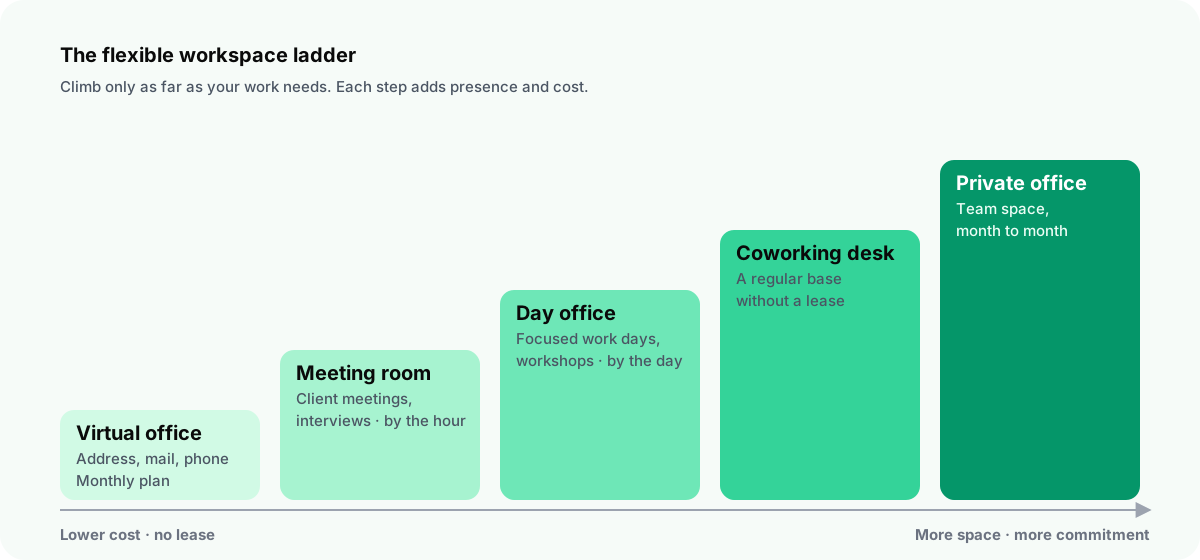
- Virtual office: a professional street address, mail handling, and in some plans a phone line. No physical desk.
- Meeting room by the hour: for client pitches, interviews, board meetings, and training sessions.
- Day office: a private room for a focused workday or small workshop.
- Coworking desk: a regular base for people who want to get out of the house.
- Private office: dedicated team space, rented month to month.
Virtual Office Plans and Pricing
The virtual office is SaGE's core product and the one most readers will start with. Here is what the New York listings showed when we checked in November 2026:
| Listing | Address | Starting price |
|---|---|---|
| East Harlem virtual office | 152 E 118th St, NYC | From $14.99/mo |
| Midtown Manhattan virtual office | 276 5th Ave, Suite 704, NYC | From $29.99/mo |
| Virtual Office Plus (Wall Street) | 48 Wall St, Suite 1100, NYC | From $41.67/mo |
| NoMad virtual office | 19 W 26th St, NYC | From $200/mo |
The Virtual Office Plus plan is the most fully specified. SaGE lists it with:
- A professional street address with up to 4 registered recipients
- Mail handling for 100 items a month, with open-and-scan and shredding for 100 items a month
- Mail storage for 30 items a month and weekly mail forwarding
- A phone line with an auto attendant, plus virtual assistant support
- 24/7 access and monthly access to meeting rooms and private day offices
Two caveats. These are "starting from" prices, and the plans offer both monthly and annual billing, so your final price depends on location, term, and add-ons. Prices also change, so confirm the current figure on the SaGE virtual office page before you commit. New sign-ups are currently offered a 5 percent welcome discount.
How Mail Handling Works
For most virtual office customers, mail handling is the feature that matters day to day. Here is the flow SaGE describes:
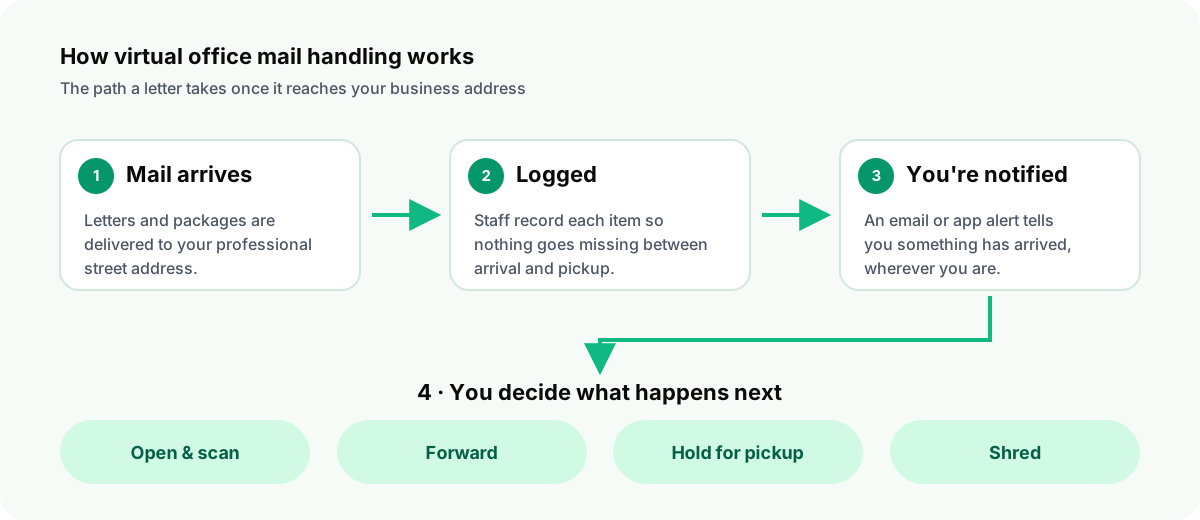
Mail arrives at your business address, staff log it, and you get a notification by email or in the app. You then choose what happens next: open and scan it so you can read it immediately, forward it to wherever you are, hold it for pickup, or shred it. For founders who travel, or who registered a company in a city they don't live in, this removes the risk of missing a tax notice, a bank letter, or a legal document.

SaGE's FAQ also says its virtual office addresses are in commercial buildings and satisfy corporate registry requirements in most jurisdictions. That is useful if you want a business address that isn't your home. Rules vary by state and country, though, so check with your registered agent or accountant before using any virtual address for company formation or banking.
Meeting Rooms and On-Demand Space
The second half of the value is physical space when you need it. SaGE lets you book meeting rooms, training rooms, and offices by the hour, day, or month, with terms of one to twelve months on monthly bookings. Its rooms are described as technology-enabled with high-speed connectivity, which is what you want for hybrid meetings where half the attendees are on a call.
Typical uses for a lean B2B team:
- A quarterly planning day for a distributed team
- Client pitches and contract signings in a professional setting
- Interview days when hiring in a new city
- Customer training sessions or small workshops
- A temporary base while you test a new market before committing to an office
Reviews featured on SaGE's site, drawn from Google, Peerspace, Giggster, and LiquidSpace, mostly praise location, staff, and how quickly hosts respond.
Which Setup Do You Need?
If you're not sure where to start, work through three questions:
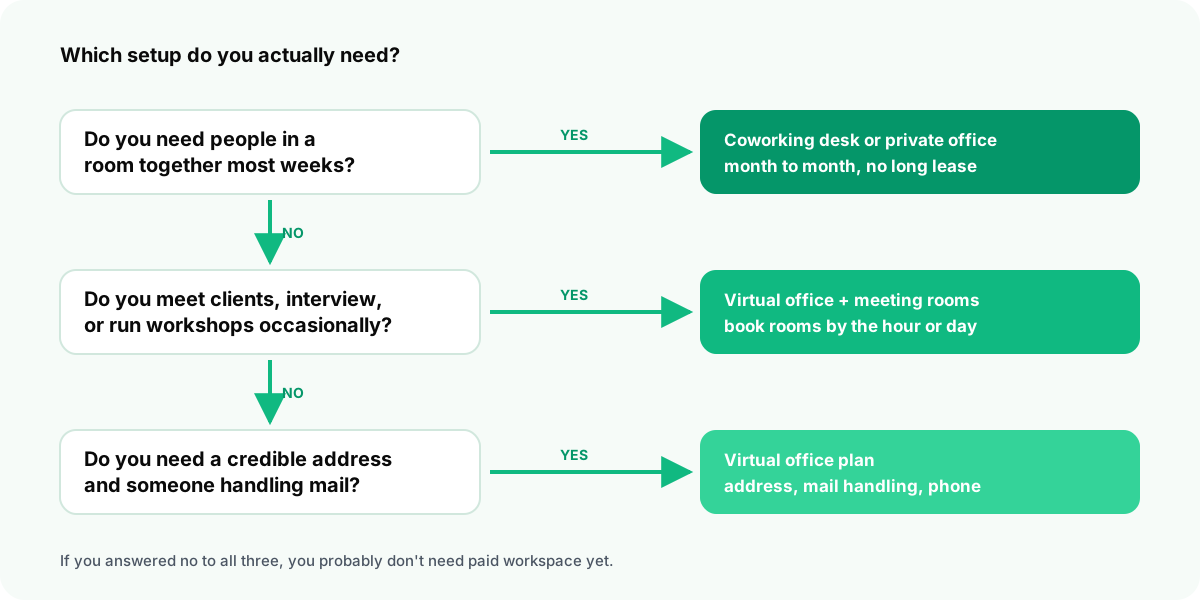
Most solo founders and remote-first teams land on a virtual office plus occasional meeting rooms. It gives you a credible presence and somewhere to meet clients for a fraction of what a lease costs. Teams that are in the same room most weeks are better served by a coworking desk or private office, still on flexible terms.

SaGE vs. a Traditional Office Lease
A conventional commercial lease typically means a multi-year commitment, a security deposit, fit-out and furniture costs, utilities, and someone to manage it all. That makes sense when a team uses the same space every day. For a team that mostly works remotely, it means paying for empty desks most of the week.
With SaGE, the fixed cost is the virtual office plan, and everything else is variable: you pay for a meeting room only when you book one. The trade-off is that you don't get a permanent space to customize or fill with your own furniture. For most early-stage and remote-first companies, that flexibility is worth more than the permanence.
How to Get Started
- Pick your city and address. Browse SaGE Workspace locations and choose the address that best fits your clients and market.
- Compare plan inclusions. Check mail volume, scanning, forwarding frequency, phone service, and meeting room access for that specific listing.
- Choose monthly or annual billing. Monthly gives flexibility; annual usually lowers the effective price.
- Book online or send an inquiry. Some listings can be booked instantly, while others ask you to send an inquiry for a quote.
- Update your address everywhere. Website, invoices, Google Business Profile, bank, and registrations, once you've confirmed the address is suitable for each use.
Pros and Cons
- Low entry price, from $14.99/mo for a New York virtual office
- Hourly, daily, and monthly bookings with no long lease
- Mail scanning, forwarding, holding, and shredding
- 28 cities across North America, Europe, Africa, the Middle East, India, and Brazil
- Online booking plus iOS and Android apps
- Pricing varies by listing and some plans are quote-only
- Inclusions differ between locations, so compare plans carefully
- Coverage is strongest in New York; smaller markets have fewer options
- Meeting room allowances on virtual plans aren't always quantified
Who SaGE Workspace Is Best For
- Solo founders and consultants who want a business address that isn't their home.
- Remote and hybrid teams who meet in person a few times a quarter.
- Companies expanding into New York or another SaGE city that want a local presence before signing a lease.
- Enterprises running training programs or multi-city events that need rooms on demand.
It is less suited to teams that need the same desks every day for years, where a traditional lease may work out cheaper over the long run.
The Verdict
SaGE Workspace is a practical option for any business that wants to look established without paying for space it doesn't use. The virtual office plans are inexpensive, the mail handling covers what most founders need, and the ability to add a meeting room or day office on demand makes it a flexible setup that grows with you. Check the inclusions for your specific location, confirm current pricing, and start on the lowest rung that covers your needs.
Explore SaGE Workspace locations and plans →
Frequently Asked Questions
How much does a SaGE Workspace virtual office cost?
New York virtual office listings started from $14.99 a month in East Harlem and $29.99 a month in Midtown Manhattan at the time of writing, with the Virtual Office Plus plan on Wall Street from $41.67 a month. Prices vary by location and billing term.
Can I use a SaGE virtual office address to register my business?
SaGE says its addresses are in commercial buildings and satisfy corporate registry requirements in most jurisdictions. Requirements differ by state and country, so confirm with your registered agent or accountant first.
Do I need a long-term lease?
No. Workspace can be booked by the hour, day, or month, and virtual offices are sold on monthly or annual plans.
Where is SaGE Workspace available?
SaGE lists 28 cities: 17 in the United States, including New York, Washington DC, Atlanta, Miami, Dallas, Houston, San Antonio, and San Diego, plus 11 international cities including Toronto, Vancouver, Montreal West, Ottawa, Dubai, Bengaluru, Brussels, Nairobi, Gaborone, Harare, and Barueri.
Susan Perry
Susan Perry writes about the mechanics of B2B growth — the tools, the tactics, and the operators using them. Based in Los Angeles. Reach her at susan@earnandsell.com.